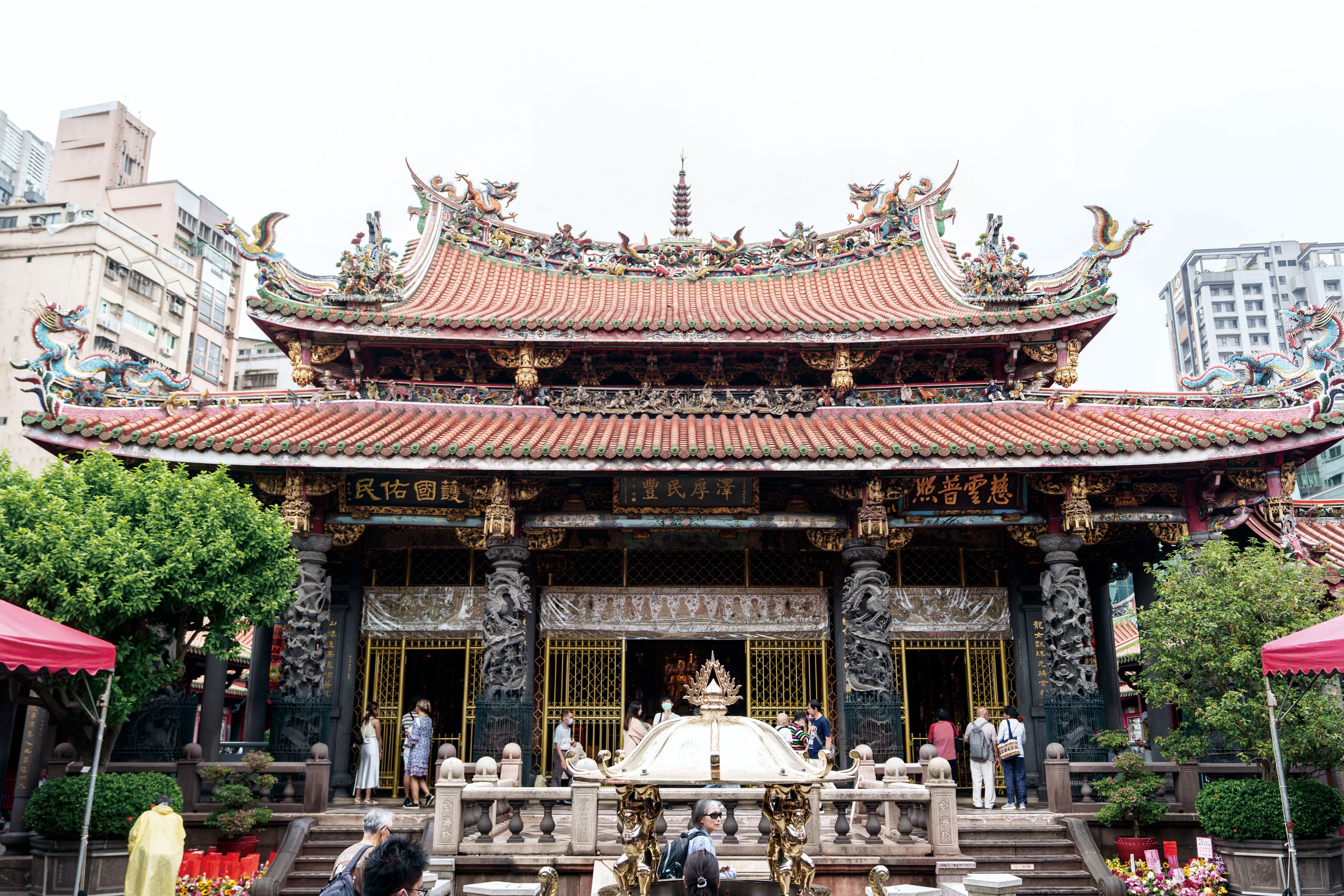
Folk Religion and Its Deities
Taiwanese folk religion is a vast and varied system. Its deities — drawn from historical figures, nature spirits, and mythological personages — number in the hundreds, and different communities, trades, and localities have their own patron gods. Several deities are of near-universal importance.
Mazu(媽祖) is the goddess of the sea and the protector of fishermen, sailors, and travellers. She is the most widely worshipped deity in Taiwan, with over 500 temples dedicated to her. She is believed to have been a historical figure named Lin Mo-niang, born in Fujian Province in 960 CE, who possessed spiritual gifts and died young while trying to save her family from a storm at sea. Her image — typically shown in an elaborate ceremonial robe and headdress, flanked by her attendants “Thousand-Mile Eye”(千里眼) and “Wind-Listening Ear”(順風耳) — is ubiquitous in coastal communities.
The two most important Mazu temples in Taiwan are Zhenlan Temple in Dajia, Taichung (home of the great annual pilgrimage described in Festivals Calendar), and Fengtian Temple in Xingang, Chiayi. Both are major pilgrimage destinations year-round, not only at festival time.
Guan Di(關帝), also known as Guan Yu, was a historical general of the Three Kingdoms period (third century CE) who is venerated as a deity of war, righteousness, brotherhood, and — somewhat paradoxically to Western sensibilities — business. He is the patron deity of both the police force and of triads, a duality that says something interesting about how moral categories are arranged in Chinese religious thought. His image, typically red-faced and imposing, with a long black beard and a glaive, is found in temples across the island and in the shrines that many businesses maintain in their premises.
Tudigong(土地公), the Earth God or Land God, is the most localised deity in the Taiwanese folk pantheon: every neighbourhood, field, and many individual buildings have their own small Tudigong shrine. He appears as a benevolent elderly man with a white beard, and his role is essentially that of a community guardian — a deity of the immediate, the local, and the everyday. The small red shrines you will see at the bases of old trees, at road junctions, and in fields throughout Taiwan are almost invariably dedicated to Tudigong.
The City God(城隍爺) is the supernatural administrator of a city or town, responsible for the welfare of its inhabitants and the keeping of moral accounts. Each city’s City God temple is often one of the most architecturally and atmospherically impressive in the area. The Taipei City God Temple in the Dadaocheng district is particularly atmospheric.