The Major Hot Spring Areas
Beitou(北投), Taipei
Beitou is the most accessible hot spring area in Taiwan — reachable by MRT from central Taipei in around 30 to 40 minutes — and the most internationally recognised. The area sits in a valley fed by geothermal water descending from Yangmingshan, Taiwan’s nearest volcanic range to the capital.
What Beitou does exceptionally well is range. Within the same area you can find free foot baths, budget public pools, traditional Japanese-era bathhouses, and upscale resort hotels. The Beitou Hot Spring Museum, housed in the original 1913 public bath building, is worth visiting for the historical context it provides on the colonial development of the site.
The spring types here include both white sulphur springs and the rarer green sulphur springs. The strongly acidic nature of the green springs means they are used for viewing rather than bathing. Most of the actual soaking facilities use the white sulphur variety or blended water.
Beitou suits visitors who want to combine a hot spring visit with Taipei sightseeing, prefer easy public transport access, or want maximum choice of venue type and price range. It is not the place to go if you are seeking a quiet rural escape — it is, in essence, an urban hot spring district.
Jiaoxi(礁溪), Yilan County
Jiaoxi sits on the flat coastal plains of Yilan County, about an hour from Taipei by train through the Xueshan Tunnel. Unlike most hot spring areas in Taiwan, which are set in mountain terrain, Jiaoxi is a low-lying town — which accounts for its unusual spring chemistry. The sodium bicarbonate springs here are fed by a different geological process than the volcanic springs of the north, resulting in clear, odourless water with a reputation for skin-softening.
Jiaoxi has a compact town centre with many hot spring hotels clustered near the train station, making overnight stays straightforward. Public foot soaking facilities exist at Tangweigou Hot Spring Park, and the town’s agricultural produce — vegetables irrigated with mineral-rich spring water — has become a local point of pride. The so-called “four treasures” of Jiaoxi include water spinach, tomatoes, sponge gourd, and water bamboo, all noted for unusual sweetness and tenderness attributed to the spring water used in irrigation.
Jiaoxi suits visitors who want an overnight hot spring town experience, easy train access, or who are combining a visit with Yilan’s broader food and nature offerings.
Wulai(烏來), New Taipei City
Wulai occupies a mountain river valley roughly an hour south of Taipei by bus from Xindian MRT station. The name Wulai comes from the Atayal language, meaning “hot and steaming” — an apt description of a place whose geothermal activity has been known to the indigenous Atayal people for hundreds of years.
The hot springs here are sodium bicarbonate, clear and odourless, associated locally with skin-softening properties. The setting — riverside pools, forested mountain ridges, a waterfall visible from the village — is more dramatically natural than Beitou or Jiaoxi. Wulai Old Street is where you are most likely to encounter Atayal food traditions, including millet wine(小米酒) and mountain-sourced ingredients. The Wulai Atayal Museum is a reasonable introduction to the cultural history of the area.
Wulai suits visitors who want a scenic, nature-integrated hot spring experience with indigenous cultural context, are comfortable with slightly higher prices, and do not need MRT-direct access.
Guanziling(關子嶺), Tainan
Guanziling is in a different category entirely — geographically, atmospherically, and geologically. Located in the low mountain foothills of Baihe District in Tainan City, it requires more commitment to reach: roughly 30 minutes by car from Chiayi, or an hour from Tainan city, with limited public transport.
The springs here are mud springs — one of only a small number of such sites globally, alongside locations in Sicily and Kagoshima, Japan. The water is grayish-black, visually unlike anything you will see at other Taiwan hot springs, and carries suspended fine mud particles from underground rock formations.
Adjacent to the spring source is a phenomenon called the Water Fire Cave(水火同源) — a site where natural methane gas has been burning continuously alongside spring water for centuries, producing a perpetual flame within a stream. It is genuinely unusual and worth seeing.
Guanziling suits visitors who are already travelling in southern Taiwan, want the most geologically distinctive hot spring experience in the country, and are happy to travel by car or scooter rather than relying on trains or MRT.
Guguan(谷關), Taichung
Guguan sits in the gorge-cut valley of the Dajia River in the mountains east of Taichung. It is a carbonic acid spring area — clear, mildly effervescent, cooler than the sulphur springs of the north. The mountain scenery is dramatic, and the area is associated with sturgeon farming, making the fish a local culinary speciality.
Guguan is more removed from major tourist circuits than Beitou or Jiaoxi, which means it tends to attract Taiwanese domestic visitors rather than international tourists. Infrastructure is functional rather than polished. It suits visitors who are already exploring central Taiwan and want to combine a mountain valley landscape with a hot spring experience that differs chemically from the more common sulphur or bicarbonate varieties.
Green Island(綠島), Taitung County
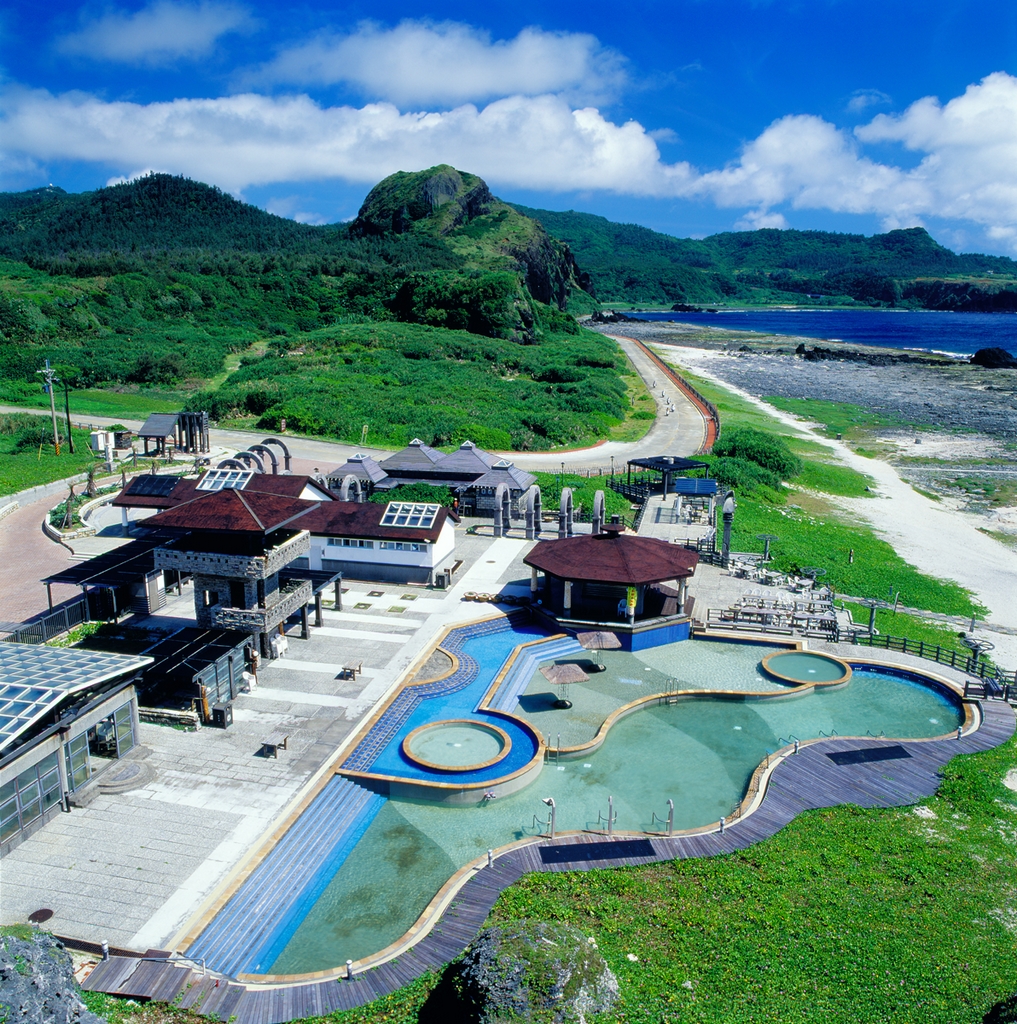
Green Island is the most extraordinary hot spring location in Taiwan, and possibly the most unusual on earth. The Zhaori Hot Spring(朝日溫泉) — whose name translates as “sunrise hot spring” — sits in the intertidal zone on the island’s eastern shore, meaning the saltwater pools are heated geothermally and directly adjacent to the Pacific Ocean. The experience of soaking in naturally heated seawater with ocean waves beside you is available in only three places worldwide.
Getting to Green Island requires either a ferry from Fugang Harbour near Taitung (roughly 50 minutes) or a short domestic flight. It is therefore best combined with a broader visit to Taitung and the East Rift Valley. The island itself has other draws — diving, cycling, and a striking coastline — making it a destination in its own right rather than a simple day trip.