Landform Types

Plains
Taiwan’s plains are concentrated along the western coast, forming a discontinuous strip from north to south. These are alluvial plains, built from sediments carried down from the mountains by rivers over thousands of years. The largest include the Chianan Plain in the southwest, the Changhua Plain in the west-central region, and the Pingtung Plain in the far south.
These plains were formed through the deposition of sediments from major river systems, particularly during flood events. Over time, these deposits accumulated to create flat, fertile land. The western plains represent less than one-third of Taiwan’s total area but contain the majority of the island’s population and agricultural land. The soil here is typically alluvial—fine-grained, nutrient-rich, and excellent for cultivation, which explains why these areas became centres of settlement.
The Lanyang Plain on the northeast coast is geologically distinct. It occupies a structural depression created by tectonic forces and is bounded by mountains on three sides. This plain demonstrates how Taiwan’s geology creates isolated pockets of flat land even on the mountainous eastern side of the island. The East Rift Valley Plain, located between Taiwan’s Central Mountain Range and Coastal Mountain Range, is one of the island’s most scenic and geologically active regions. Stretching roughly 180 kilometers from Hualien to Taitung, it features cultural diversity, home to indigenous communities such as the Amis and Bunun, whose traditions and festivals add depth to the region’s natural beauty.
Basins
Basins are low-lying areas surrounded by higher terrain. Taiwan’s most significant basins are the Taipei Basin in the north and the Taichung Basin in the west-central region. These aren’t river valleys but rather structural depressions created by tectonic activity and subsequently filled with sediments.
The Taipei Basin, where Taiwan’s capital sits, was once a lake. Approximately 20,000 years ago, river erosion breached the basin’s natural rim, draining the lake and leaving behind thick deposits of lacustrine (lake) sediments mixed with river alluvium. These soft sediments amplify seismic waves during earthquakes, making the basin particularly vulnerable to ground shaking: an important consideration in urban planning.
The Taichung Basin formed through similar processes but has a different sedimentary composition, reflecting its distinct drainage patterns and geological history. Both basins became major population centres because they offered flat land suitable for settlement and agriculture, surrounded by natural defensive barriers.
Tablelands (Terrace)
Tablelands, or terraces, are elevated flat surfaces that rise abruptly from surrounding plains. Taiwan’s tablelands are primarily found along the western foothills. The Linkou Plateau northwest of Taipei is perhaps the most prominent example.
These features formed through two main processes. First, ancient rivers deposited thick layers of gravel and sediment during periods when sea levels were higher or when the land was lower. Then, as tectonic forces uplifted the island, these old river deposits were raised above their original elevation. Subsequent erosion carved away the surrounding material, leaving the harder, gravel-rich deposits standing as elevated plateaus.
The Linkou Plateau has a distinctive red soil (laterite) capping, formed by prolonged weathering in a warm, humid climate. The presence of this ancient weathered surface tells us that this tableland has been exposed to the elements for a considerable time: at least several hundred thousand years.
Hills
The hilly terrain of Taiwan occupies the transition zone between the western plains and the central mountains. These aren’t simply small mountains; they represent a distinct geological zone composed primarily of sedimentary rocks that are younger and less consolidated than those in the high mountains.
The Western Foothills, which run north-south parallel to the coast, consist of marine sedimentary rocks that were deposited on the ocean floor and subsequently uplifted. These rocks are relatively soft and easily eroded, creating the rounded, vegetation-covered hills characteristic of this region. Elevations typically range from 100 to 1,000 metres.
Mountains
Mountains dominate Taiwan’s landscape. The Central Mountain Range forms the island’s backbone, running north-south for approximately 270 kilometres and containing more than 260 peaks exceeding 3,000 metres. Yushan (Jade Mountain), Taiwan’s highest peak, rises to 3,952 metres, making it taller than any mountain in Northeast Asia.
Taiwan’s mountains are geologically young, which explains their dramatic relief and steep slopes. Unlike older mountain ranges that have been worn down by millions of years of erosion, Taiwan’s peaks are still being actively uplifted. In the highest regions, the uplift rate exceeds the erosion rate, meaning the mountains are actually growing taller.
The central mountains are composed primarily of metamorphic rocks like schists, gneisses, and marble, that were originally sedimentary rocks transformed by intense heat and pressure deep within the Earth’s crust. These hard, crystalline rocks give the high mountains their structural integrity and ability to maintain steep faces.
Taiwan’s mountainous core is dominated by the north‐south trending Central Mountain Range, which spans much of the island’s length. On its western flank lie several subsidiary ranges (including the Hsuehshan Range in the north, and towards the southwest the Yushan and Alishan ranges). On the eastern side is the Coastal Range (Hai’an Range), which is geologically distinct: it consists largely of accreted volcanic-arc materials that were brought in by the Philippine Sea Plate and sutured onto the Eurasian continental margin during the arc-continent collision.
Volcanoes

Taiwan’s volcanic features are concentrated in the north, particularly in the Tatun Volcano Group near Taipei and on offshore islands. These volcanoes are related to the subduction of the Philippine Sea Plate beneath the Eurasian Plate, though the volcanic activity here is complex and not fully understood.
The Tatun Volcano Group consists of more than 20 volcanic edifices, the tallest being Mount Qixing (Seven Star Mountain) at 1,120 metres. These are stratovolcanoes, built from layers of lava flows and pyroclastic material. Whilst no historical eruptions have been recorded, geothermal activity: hot springs, fumaroles, and sulfur deposits, indicates that the system is not extinct but rather dormant. Recent research suggests that magma still exists beneath these volcanoes, making them potentially active.
The volcanic islands in the Taiwan Strait and offshore from the northeast coast provide additional evidence of volcanic activity. Penghu is built entirely from basaltic lava flows, displaying spectacular columnar jointing where lava cooled and contracted into hexagonal columns. Guishan Island off the coast of Yilan is a volcanic island with active hydrothermal vents offshore.
Green Island and Orchid Island off Taiwan’s southeast coast are also volcanic in origin, though their volcanic activity ceased long ago. Their geology differs from that of northern Taiwan, reflecting different tectonic settings and magma sources.
Rivers
Taiwan’s rivers are short, steep, and powerful. Because the island is narrow and the mountains are close to the coast, most rivers travel less than 100 kilometres from source to sea. What they lack in length, they compensate for in gradient and velocity.
The island’s rivers demonstrate a fundamental geological principle: flowing water is one of Earth’s most powerful erosive forces. Taiwan’s rivers carry enormous sediment loads, particularly during typhoons when flow rates can increase a hundredfold within hours. This sediment transport is why Taiwan’s western plains exist: they’re built from material eroded from the mountains and deposited at lower elevations.
Major river systems include the Zhuoshui River (the longest at 186 kilometres), the Gaoping River in the south, the Dajia River in the centre, and the Danshui River system serving the Taipei Basin. Each has carved deep valleys into the mountain bedrock, creating dramatic gorges in places.
The Liwu River has carved the spectacular Taroko Gorge through marble bedrock, creating vertical walls up to 1,000 metres high. This gorge exemplifies how Taiwan’s geology creates its most impressive scenery: hard metamorphic rock (marble) allows near-vertical cliffs to stand, whilst ongoing uplift means the river must continuously cut downward to maintain its path to the sea.
River valleys in Taiwan often display terraces: step-like features on valley sides representing old river levels. These terraces form because the land is uplifting. As the mountains rise, rivers cut downward through their own former floodplains, leaving elevated remnants of older valley floors as terraces. Counting and dating these terraces allows geologists to reconstruct the uplift history of different regions.
Coasts
Taiwan’s coastline varies dramatically depending on local geology and tectonic setting. The contrast between different regions is particularly striking and reflects fundamental geological differences.

The northern coastline of Taiwan, stretching from Tamsui to Yilan, is shaped by volcanic activity from the Datun and Keelung complexes. It features rugged cliffs, basaltic headlands, and wave-cut platforms such as Yehliu and Bitou Cape, where erosion has created flat rock surfaces at the wave zone. Differential erosion, where softer rocks erode faster than harder rocks, has created bizarre rock formations that attract photographers and tourists. Composed mainly of andesitic lava and tuff, it shows strong marine erosion under the influence of the Kuroshio and China Coastal Currents, which create rough seas and striking erosional landforms.

The western coastline extends from Tamsui south to Kaohsiung and is dominated by wide alluvial plains and river deltas. Its geology consists of young marine and fluvial sediments including sand, silt, and clay, deposited in the low-lying Taiwan Strait margin. The sandy barriers and lagoons of the southwest coast, where wave action has built barrier islands that partially enclose shallow lagoons. These dynamic environments shift with storms and seasonal wave patterns. The sea is shallow and calm, with tidal flats and wetlands formed under weak wave energy, making this coast highly suitable for sediment accumulation and mangrove growth.
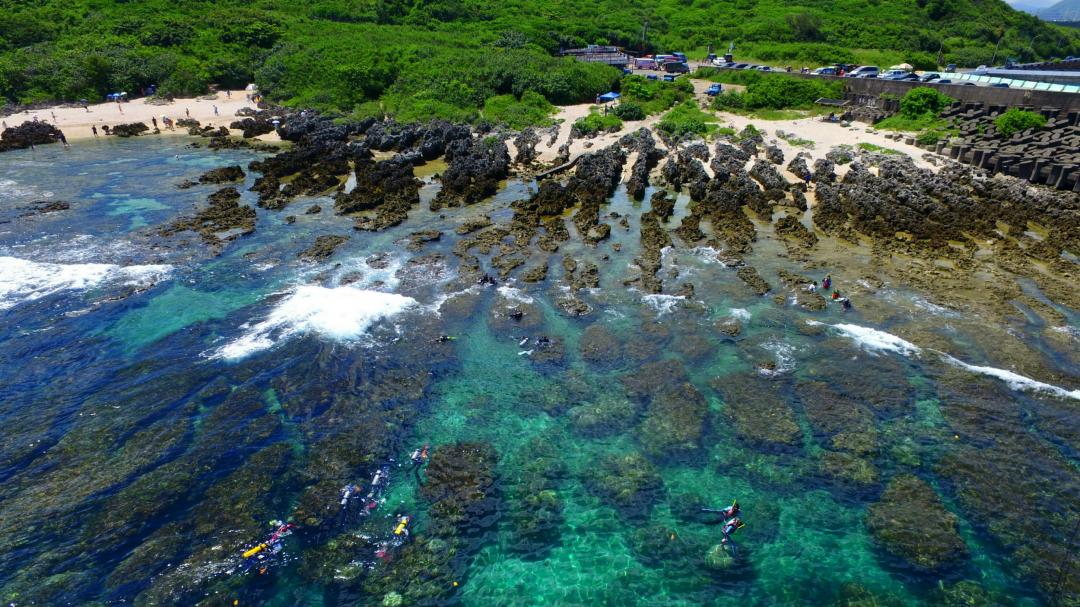
The southern coastline, curving around Cape Eluanbi, is marked by coral reefs, uplifted limestone terraces, and sandy beaches. Its bedrock consists mainly of reef limestone and sandstone, shaped by uplift and marine erosion. Warm waters of the Kuroshio Current bathe this tropical coast, fostering clear seas, vibrant coral ecosystems, and distinctive marine terraces. These reefs are both modern (still growing offshore) and ancient (uplifted above sea level by tectonic forces).

The eastern coastline, running from Hualien to Taitung, faces the Pacific and is steep and tectonically active. Sheer cliffs, narrow beaches, and uplifted marine terraces rise from the sea, formed from volcanic and sedimentary rocks of the Coastal Range. This coast is rising rapidly due to tectonic uplift, which explains the presence of coral reefs and marine terraces elevated high above current sea level. Some marine platforms now sit more than 100 metres above the waves, testament to the island’s rapid rise. The deep offshore Pacific and the strong Kuroshio Current create high waves and rapid coastal erosion, giving this coast its dramatic and rugged character.